
 Čeština
 Slovenčina
 Hrvatski
 Română
 Magyar
 български език
 Deutsch
 Français
 Українська
 Nederlands
 Polski
Is an electronic drum kit worth buying?
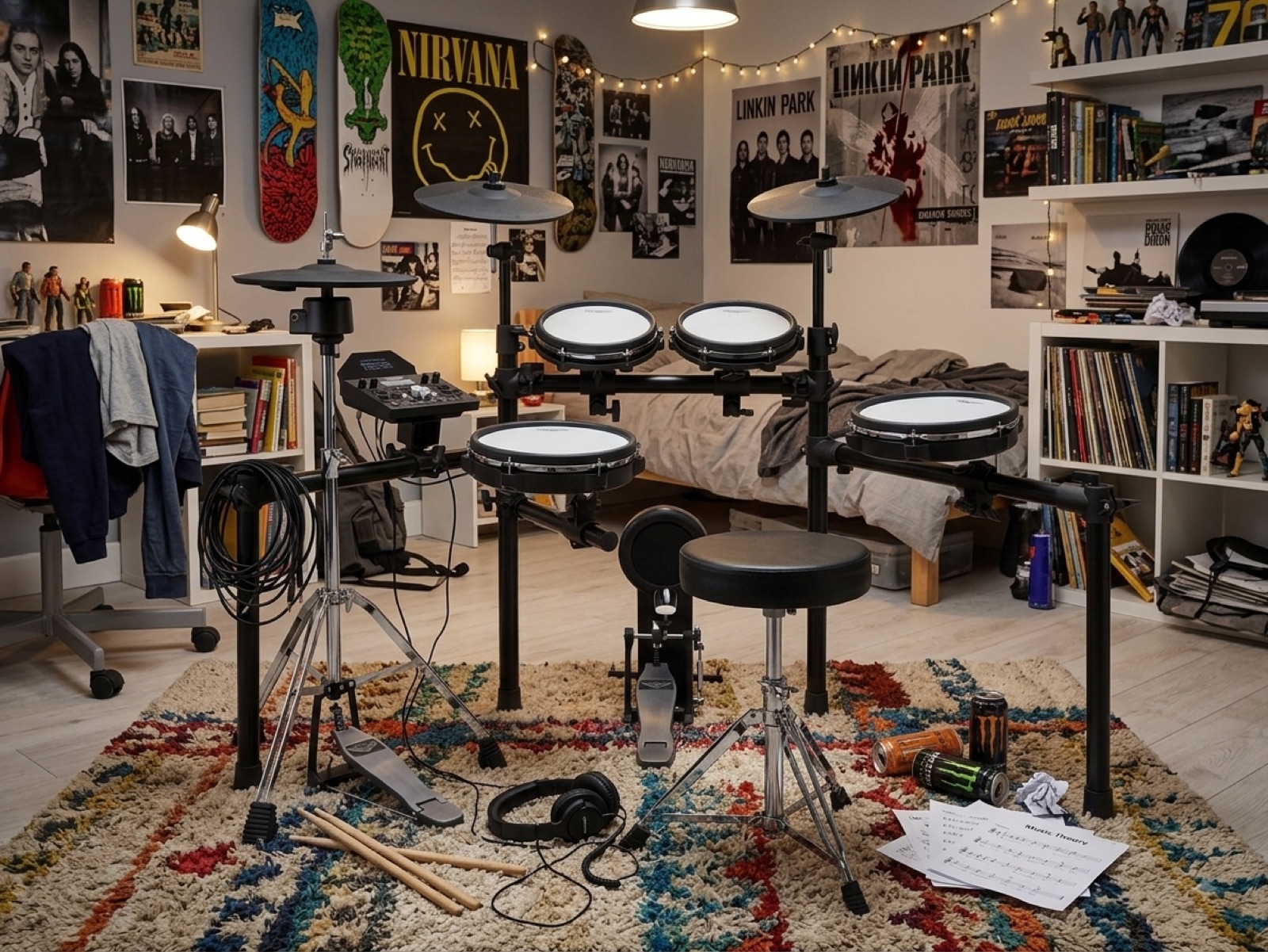
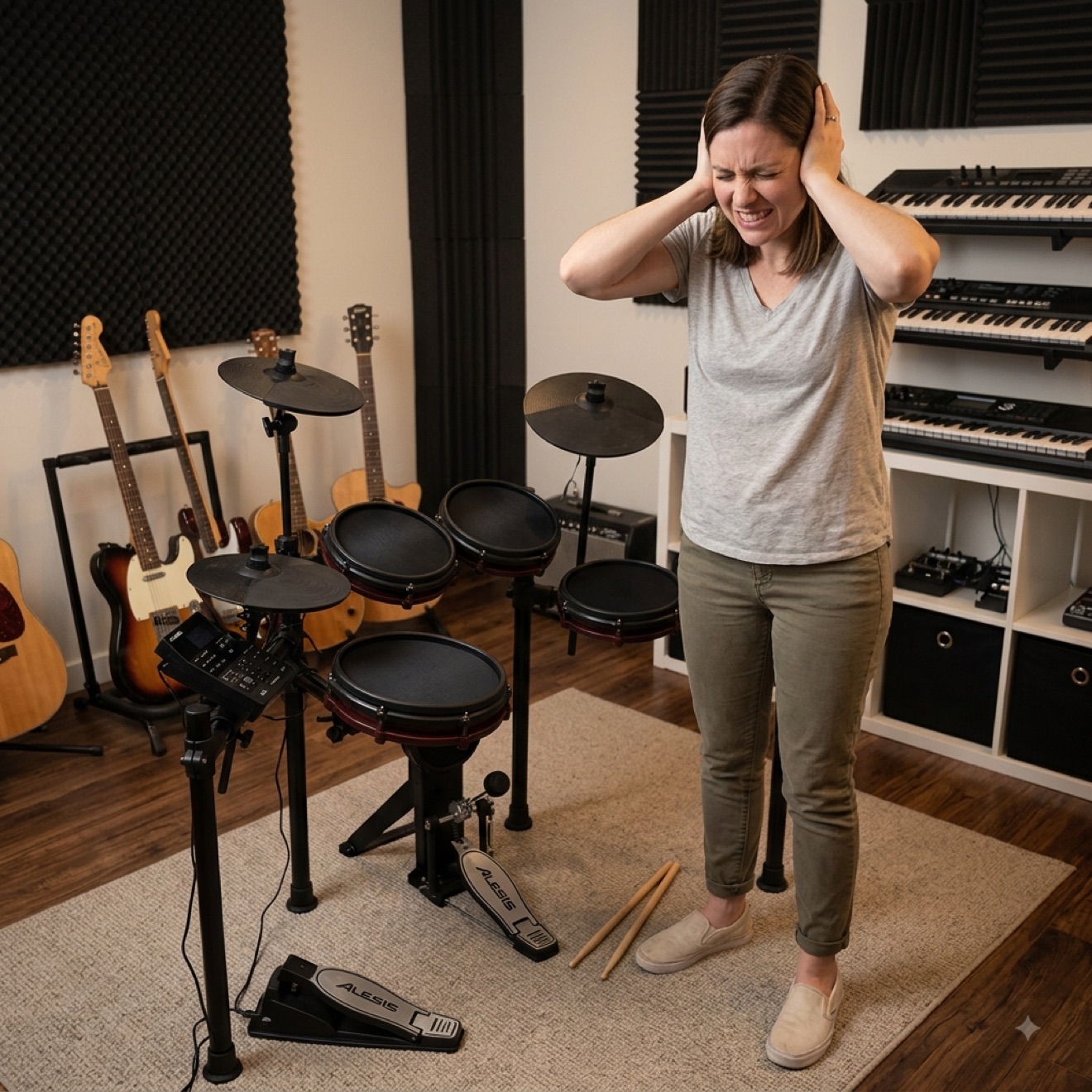
The most common call we get goes roughly like this: „I live in a block of flats, my son wants to play drums, and the neighbour has already banged on the radiator once. Can this be sorted out somehow?”
It can, but not in the way most people imagine. Below we describe what electronics really solve and what they do not — without sugar-coating, because sending an instrument back after two weeks is no fun for anyone.
Quiet that is not complete silence
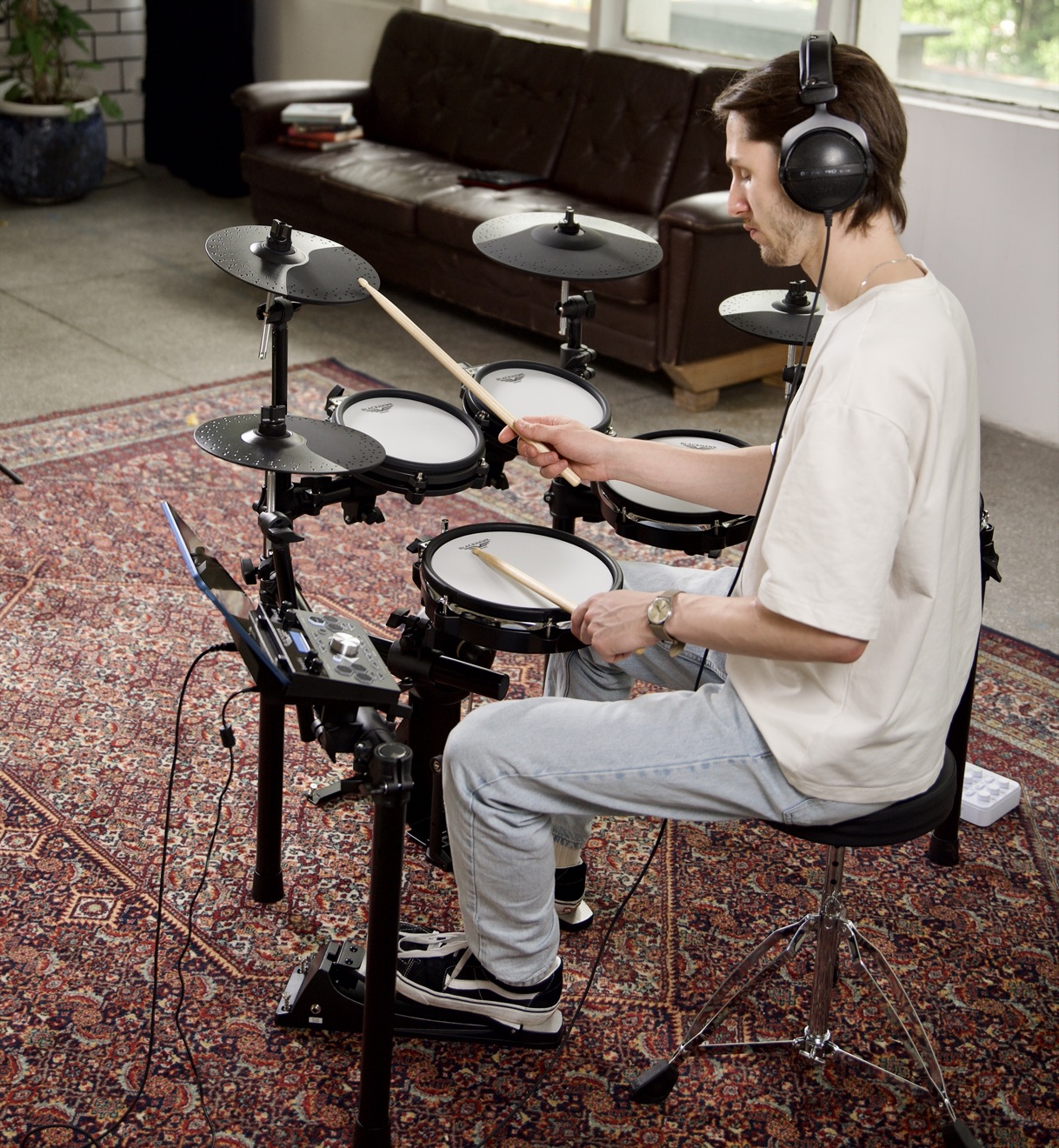
Mesh pads damp the strike down to the level of a soft tap — from the next room with the door closed you can barely hear it. The problem, however, is not the sound in the air but the vibration carried through the floor. The kick striking the bass pad makes a thud in the ceiling, and that is what the neighbour below hears, not the sticks.
That is why the first thing we ask about is the floor and the type of building. In an old tenement house with wooden floors you have to allow for a riser or a thick mat under the kit. In modern construction with a screed over insulation, the mat alone is usually enough. That is an outlay of around fifty euros and it saves a great deal of stress.
How much space it takes
A home-sized kit fits into an area of about 120 × 100 cm — roughly the footprint of a desk with a chair. The rack folds away in a few minutes, but honestly, hardly anyone folds it up daily. It is worth assuming from the start that the instrument will stand permanently in a corner of the room.
What you get in the box
This is where shops really differ. In many offers a „kit” means the rack and pads alone — to actually play you still have to buy a throne, headphones and sticks, which can add a couple of hundred euros to the bill.
In our Black Hawk Pulse kits the throne, headphones and sticks are included — you unpack, assemble and play the same evening. If you want a real hi-hat stand instead of a pad on the rack, the same kit comes in the Pulse VH version. Players who have been at it a little longer usually miss a second crash and a fourth tom — then the Pulse Pro or the Pulse Pro VH, which combines both, makes more sense.
What electronics will not replace
We are not going to pretend that a cymbal pad behaves like sheet bronze. An acoustic cymbal responds differently to a strike on the edge, on the bell and at various points across its surface, and its decay depends on force and angle. Pads reproduce this better and better, but a drummer with ten years behind them will feel the difference in the first minute.
The same goes for the snare: on an acoustic kit the difference between a delicate ghost note and a firm strike is enormous and audible in the timbre, not only in volume. The module reproduces that difference in a simplified way.
Electronics win, on the other hand, everywhere an acoustic kit is simply impossible — and that applies to most flats.
When we advise against it
If you have your own house, a cellar or a garage and nobody objects to the noise, buy an acoustic kit. For the same money you get an instrument that sounds better and teaches technique without compromise. Electronics make sense when quiet, space or the ability to play after ten in the evening are a condition, not a bonus.
Frequently asked questions
Will the neighbours hear me playing in headphones?
They will hear the kick if you live above someone and the kit stands directly on the screed. A damping mat or a riser with rubber pads reduces this enough that in a typical block it stops being a problem. The sticks and pads themselves are practically inaudible through a wall.
Can you learn to play „seriously” on an electronic kit?
Yes, with one reservation: cymbal technique and snare dynamics are worth checking on an acoustic kit from time to time — at a lesson or a rehearsal, for instance. Rudiments, limb independence, timing and reading notation are practised just as well on an electronic kit, and you have a metronome and recording built into the module.
Can I connect it to a computer?
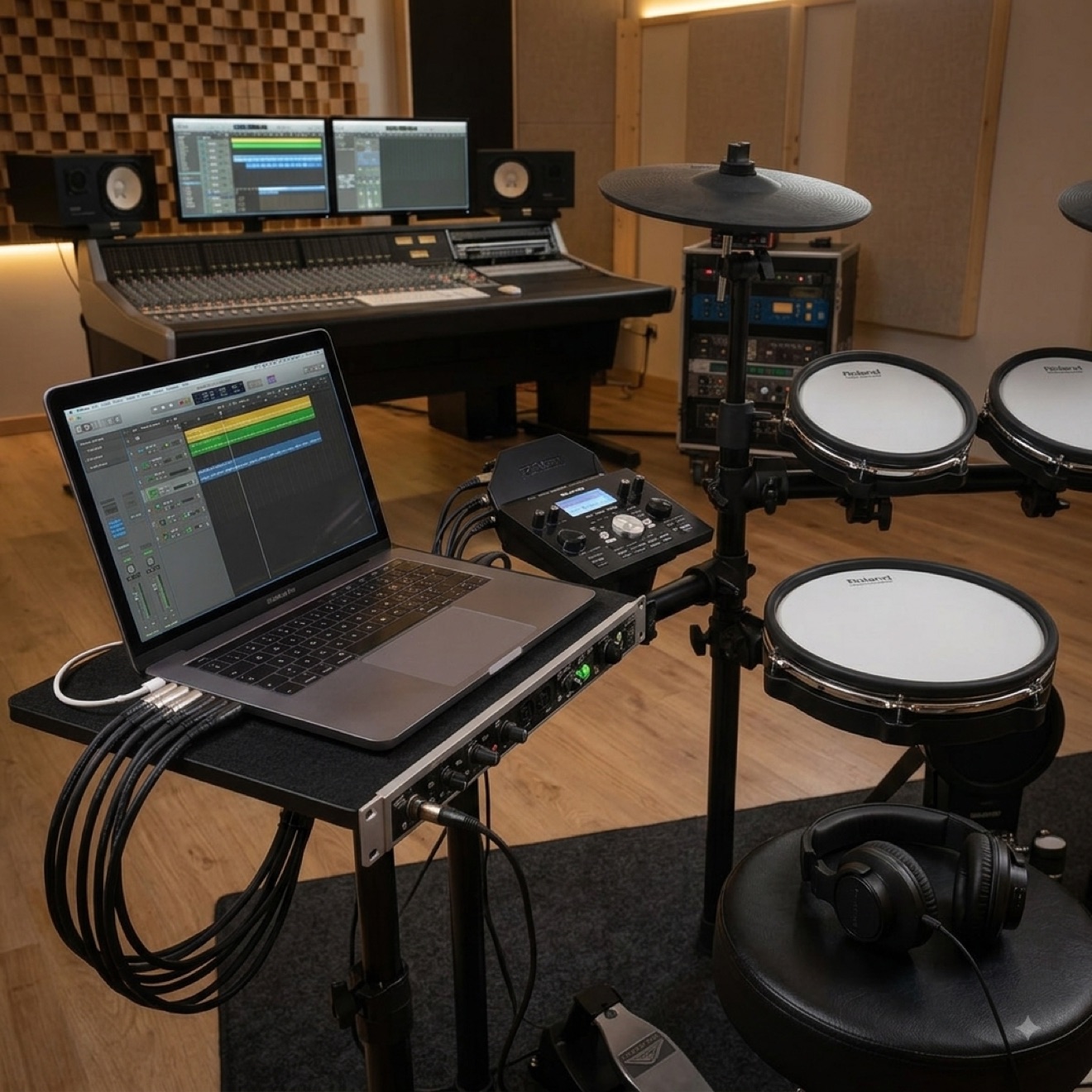
Yes, over USB. The module sends MIDI, so you can drive software such as EZdrummer or Superior Drummer and record parts in any DAW. That is in fact the most common reason people recording at home reach for an electronic kit.
How long do mesh heads last?
Mesh is a wear part, much like a head on an acoustic kit. Playing an hour a day you usually replace it once every few years, and the replacement itself takes a few minutes and costs a few euros per pad.
Is a second-hand kit worth buying?
It can pay off, but pay attention to the module — it is the most expensive part and the hardest to repair. An alternative is ex-display stock: it carries light marks of use but comes with a full warranty and service, so the risk is incomparably lower than buying from a classified ad.
Where do I start if this is the first instrument in the house?
With a complete kit including accessories, and a mat underneath. Buying the throne and headphones separately usually ends up costing more than a kit that already has everything.
If you are leaning towards buying, start by comparing complete kits — in our electronic drum kits the throne, headphones and sticks are already included.
This article was originally written in Polish and translated with the help of automated tools. If anything is unclear, please contact us.