
 Čeština
 Slovenčina
 Hrvatski
 Română
 Magyar
 български език
 Deutsch
 Français
 Українська
 Nederlands
 Polski
Are electronic drums loud?
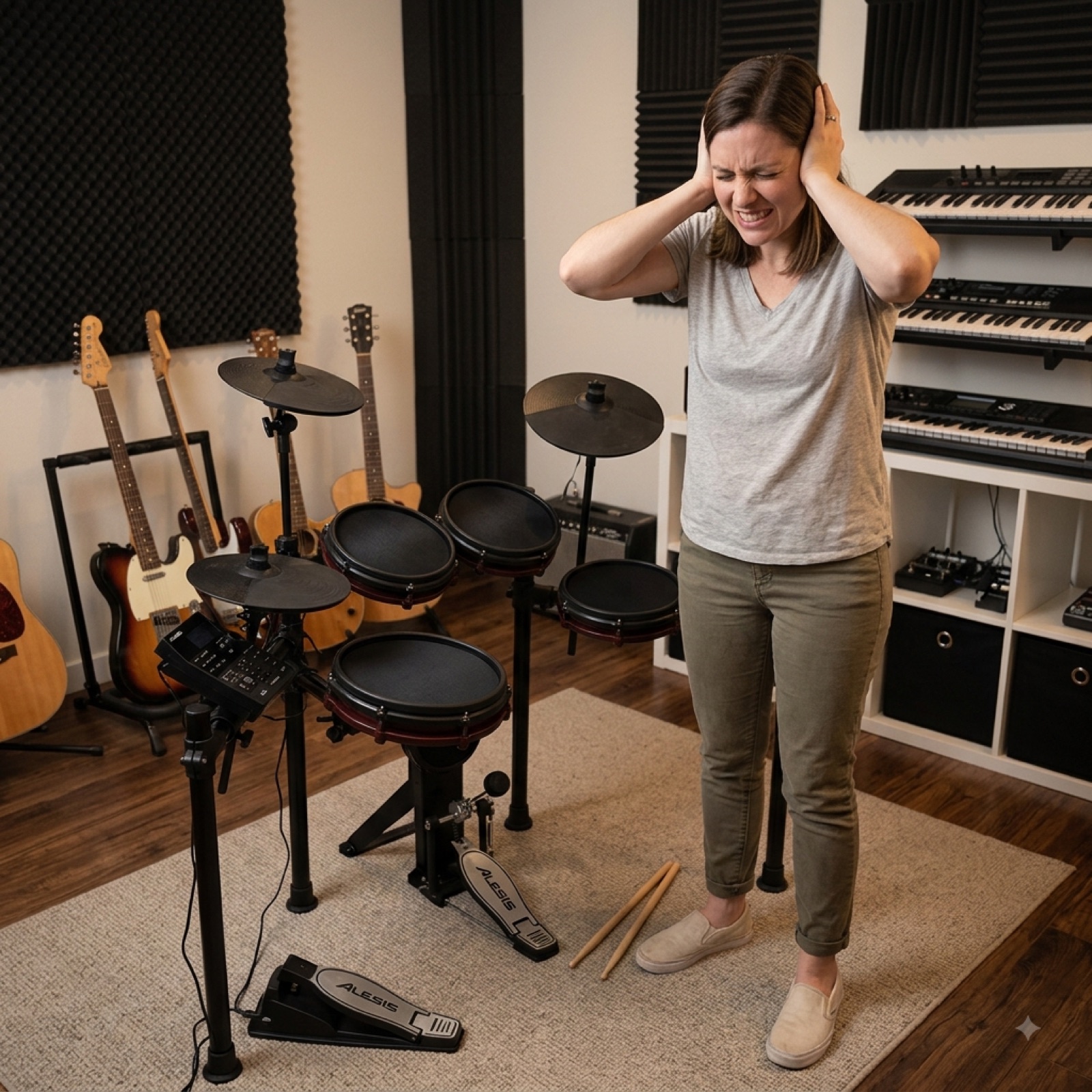
The question comes up in almost every phone call, and it usually means something other than it says. Customers are not asking about decibels — they are asking whether the neighbours will complain.
The answer: an electronic kit is far quieter than an acoustic one, but it is not silent. It is worth knowing exactly what can be heard, because that determines how you deal with it.
Three different noises, not one
The stick hitting the pad is the quietest part of the puzzle. A mesh head sounds a little like tapping a finger on stretched fabric. Through a closed door it is practically inaudible, through a wall even more so.
The kick pedal striking the bass pad is a completely different story. The beater hits the surface with enough force to set the whole frame vibrating and, through the rack legs, the floor. The neighbour below does not hear a sound — they feel rhythmic thumping in the ceiling. It is exactly the mechanism that makes a washing machine audible during the spin cycle.
A hi-hat on a stand adds a third element: the pedal mechanism itself works mechanically and clatters.
What to do about it
In order of effectiveness: a mat under the whole kit, then a riser with rubber isolators, and finally small touches such as felt pads under the rack legs.
A thick wool or rubber mat costs around fifty euros and in a building with a concrete floor slab it is usually enough. In an old tenement house with wooden floors that alone will not settle the matter — there a riser built from board on rubber pucks works, cutting the vibration off from the floor. It sounds like a big project, but it is an hour of work and a hundred euros of materials.
The second trick is simpler: do not play in slippers. Soft footwear on the kick pedal damps part of the impact at the source.
The volume is under your control
You hear the instrument only in headphones or through a connected monitor — nowhere else. That is the fundamental difference from an acoustic kit, where the sound level can rival a pneumatic hammer and cannot be turned down. Here you set the level with a knob on the module.
The Black Hawk Pulse kits come with headphones included, so from the very first evening you play on your own terms. If you want a real hi-hat stand instead of a pad, choose the Pulse VH version — just remember that the stand also brings that extra mechanical clatter.
Realistic expectations
In a typical flat, with a mat under the kit, playing in headphones at ten in the evening should not bother anybody. Playing at two in the morning in a tenement house with wooden floors may bother people even with a riser. Electronics solve ninety per cent of the noise problem, not a hundred.
Frequently asked questions
How many decibels does an electronic kit produce?
The strike on a mesh pad itself is about 60–70 dB close up, roughly the level of a conversation. An acoustic kit reaches 100–110 dB, a level that damages hearing over time. In a flat, though, the problem is not that noise but the kick vibration carried through the building structure.
Are rubber pads quieter than mesh?
The opposite — rubber is louder and harder in rebound. A mesh head damps the strike more effectively and reproduces stick rebound better, which is why we use it in the Pulse kits.
Does a mat really help?
Yes. Against vibration carried through the floor it is the single most effective purchase. It will not remove it completely, but you hear the difference immediately — especially if the kit previously stood directly on laminate.
The neighbour complains despite the headphones. What now?
It is almost always the kick. Check that the kit does not touch the wall, add a mat or a riser, reduce the spring tension on the pedal and think about the time of day. If that does not help, the building structure is to blame, not the instrument.
Can I play without headphones?
Yes, through a monitor or an amplifier — but then the volume depends entirely on you and you are back in the acoustic situation, only with a control knob.
If quiet playing matters to you, look at how the bass drum pad and the rack are built — that is what the neighbours hear. We describe this for each of our electronic drum kits.
This article was originally written in Polish and translated with the help of automated tools. If anything is unclear, please contact us.