
 Čeština
 Slovenčina
 Hrvatski
 Română
 Magyar
 български език
 Deutsch
 Français
 Українська
 Nederlands
 Polski
How much does a good electronic drum kit cost?
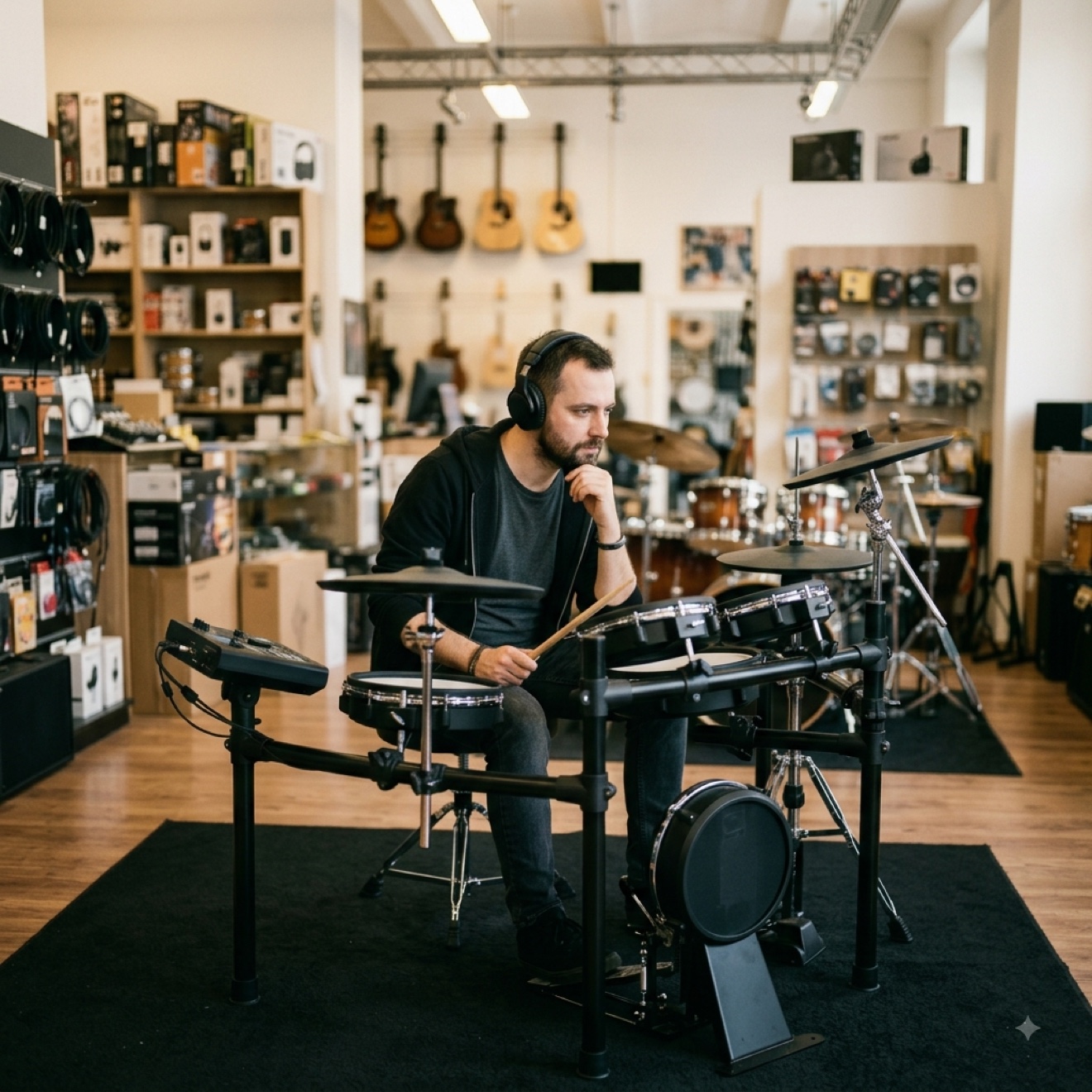
Which parts of a kit are genuinely worth paying more for and which are mostly marketing — from the snare and sensors to the durability of the components.
When buying your first electronic drum kit it is very easy to fall into the trap of comparing kits on price alone. One costs a little over 1000 złoty, another 2000, and professional models can cost as much as a used car.
Is a more expensive electronic kit really better? And — more importantly — which parts are worth paying extra for, and which are mostly marketing?
In practice a good electronic kit doesn't have to cost a fortune. You do, however, need to know which parts genuinely affect playing comfort, dynamics, durability and your room to grow later on.
How much do you need to spend on an electronic drum kit?
The market can be loosely divided into several segments.
Around 1000–1500 złoty — entry-level kits
In the lowest price range you'll mostly find small kits intended for beginners.
They can work well as a first contact with the instrument, but compromises often appear:
- small pads,
- plain rubber surfaces,
- a limited number of zones,
- a small rack,
- a basic sound module,
- a simple kick pad or a bare pedal without a classic beater,
- simpler sensors and components.
If someone simply wants to check whether they'll enjoy playing drums, such a kit may be enough.
The problem appears once you start playing regularly. That is when the things that initially seemed unimportant begin to matter enormously.
Around 1500–3000 złoty — this is where the genuinely interesting kits begin
This is probably the most important segment for anyone looking for their first good electronic kit.
In this range you can already expect:
- mesh pads,
- a larger snare,
- several strike zones,
- the ability to damp cymbals by hand,
- better response to dynamics,
- a classic kick pedal,
- a steadier rack,
- USB MIDI,
- Bluetooth,
- working with a computer and drum software.
And it is precisely here that it pays to look not only at the maker's logo, but above all at what you actually get for the money.
A good example is the Black Hawk Pulse.
Black Hawk Pulse — an example of a kit where the extra money goes on things you really use
In designing the Black Hawk Pulse we concentrated above all on the elements that have a direct bearing on playing.
Instead of extending the feature list with things most users will probably never touch, we put our effort into the mechanics of the kit, the sensors, the pads, durability and the instrument's ability to work with a modern music setup.
The Pulse uses mesh pads, which give a more natural stick rebound and are far more pleasant during long practice.
The snare, however, is particularly important.
In the Black Hawk Pulse we fitted a 10-inch snare pad using four sensors, supporting among other things rimshot and cross stick.
Why does this matter?
Because with electronic drums it isn't only about the module registering a stroke. What also matters is where, how hard and in what manner you strike the pad.
The better a kit reads the way a drummer plays, the less it feels like operating an electronic controller and the more it feels like playing an instrument.
What is genuinely worth paying extra for?
1. A good snare
If we had to name one element on which it isn't worth economising too much, it would be exactly the snare.
It takes an enormous share of all the strokes you play. A small, hard pad may be sufficient during the first lessons, but with regular practice a larger surface, properly designed sensors and the way the module interprets strokes make an enormous difference.
A good snare should correctly recognise not only ordinary head strokes but also techniques such as rimshot and cross stick.
And this is exactly where one of the important differences appears between simpler constructions and the system used in the Black Hawk Pulse.
In many electronic kits, telling a rimshot from a cross stick works in a simplified way. Instead of genuinely recognising how the stroke was made, the electronics may go largely by its force. As a result a hard stroke on the rim alone can trigger the rimshot sound, while a gentler one is read as a cross stick.
That means the pad doesn't always recognise a true rimshot technique, but mostly interprets the signal level from the rim.
The Black Hawk Pulse approaches this differently.
The 10-inch Pulse snare uses four sensors and analyses the behaviour of both the head and the rim. Thanks to that the rimshot is recognised in a way that matches the technique known from an acoustic snare — it appears when the stick strikes the rim and the head at the same time.
A merely harder stroke on the rim is therefore not treated as a substitute for a rimshot.
This matters greatly not only for realism but also for learning. From the outset the drummer develops correct technique instead of getting used to the behaviour of an electronic pad that doesn't match what would happen on a real snare.
Progressive dynamics from the edge to the centre
The capabilities of the Pulse snare don't end there.
One of its most important features is a progressive dynamic response depending on where the head is struck.
On an acoustic snare the sound and the character of the response are not identical across the whole head. A stroke closer to the rim behaves differently from a stroke in the central part of the head. Drummers use that difference deliberately, changing the articulation and expression of their playing.
The Black Hawk Pulse snare reproduces this behaviour.
As you move the point of impact from the edge towards the centre of the head, the instrument's response changes progressively. So we are not dealing merely with a simple "soft stroke — hard stroke" scheme. Where the stick lands on the head matters too.
That makes the snare behave more like an acoustic instrument and less like an electronic pad triggering a sample.
In many simpler electronic constructions the pad responds above all to the force of the stroke. Whether you hit closer to the centre or to the edge of the head, the response stays very much the same.
On the Pulse the position of the stroke becomes another element of expression.
Combined with the four sensors, correct rimshot detection and cross stick support, this means the 10-inch Pulse snare reproduces far more accurately the way a drummer works on a classic snare.
And it is exactly for solutions like these that it is worth paying extra.
Not for another few dozen sounds in the module's menu, but for technology you can feel with every stroke of the stick.
2. Mesh pads instead of hard rubber
Mesh heads are not merely something that improves the look of a kit.
They affect:
- stick rebound,
- comfort for the hands,
- the ability to adjust tension,
- the level of mechanical noise,
- the overall feel of playing.
If you plan to practise several times a week, the difference between a plain rubber pad and a properly tensioned mesh head is very pronounced.
That is why mesh is one of the first things worth paying extra for when choosing an electronic kit.
3. Larger pads
It is easy to overlook pad diameter in the specification.
Yet the difference between a small pad and a surface closer to the dimensions of a real drum affects the way you move around the whole kit.
In the Black Hawk Pulse we used:
- a 10" snare,
- 8" toms,
- a 10" floor tom.
Thanks to that the kit stays compact while still keeping more natural proportions during playing.
A bigger pad won't automatically make us better drummers. It will, however, make the move from an electronic kit to an acoustic one more natural.
4. Multi-zone cymbals
On very simple kits a cymbal may work like one big button. You strike it — you hear a crash.
On more advanced constructions the instrument responds differently depending on where and how it is struck.
In the Black Hawk Pulse we fitted, among other things, a three-zone 12" ride with a choke function.
That makes it possible to obtain different responses depending on the zone of the cymbal and to stop it ringing by catching the edge with your hand.
These are small things, until you start playing more advanced parts. After that they become practically indispensable.
5. A good kick pad
The cheapest electronic kits often use very simplified pedals.
They let you start learning, but they don't always reproduce the work of a classic bass drum pedal well.
If you care about developing the right habits, it is worth choosing a construction that uses the classic mechanism with a beater.
The Pulse has a mesh kick pad, designed also with a view to limiting mechanical noise during practice at home. That is especially important for people living in a block of flats.
6. A steady rack
This is one of the most underrated elements of an electronic drum kit.
In a photograph practically every rack looks similar. The difference appears while playing.
If a harder stroke shifts the tom, turns the cymbal on its mount and starts moving the whole construction, even a good module won't save your playing comfort.
In the Black Hawk Pulse we used a rack built from 38 mm tubing.
Stability matters especially if you plan to expand the kit with extra elements later on.
7. Durability of sensors and components
This is one of the parameters that practically cannot be judged from the specification table alone.
An electronic drum kit is an instrument subjected to thousands of repeated strokes. The snare pad, the tom, the cymbal or the kick must not only register a stroke correctly, but do so reliably over a long time.
In some budget kits the savings also cover the sensors, the wiring, the connections and other parts inside the pads. Problems may only appear after some time of use.
The symptoms vary considerably:
- the pad starts responding more weakly,
- single strokes are not registered,
- the tom works erratically,
- the kick stops detecting some strokes,
- one of the cymbal zones starts behaving randomly,
- the sensor responds differently during more intense playing.
The most frustrating part is that such a fault doesn't always mean a complete failure.
A pad may register nine strokes correctly and simply miss the tenth.
During practice that is annoying. During a recording it can ruin a whole take, and during a live performance it can throw the drummer off the beat.
On the Pulse, durability was one of the priorities.
In designing the Black Hawk Pulse we paid close attention not only to how the sensors work, but also to their long-term durability.
We used high-quality components intended to work through tens of thousands of repeated strokes. That covers the snare, the toms, the cymbals and the parts responsible for kick detection.
A good pad should not only respond superbly on the first day out of the box. It should work the same way after many months of regular playing too.
Our service record so far bears this out — the number of warranty claims concerning failures of pads and sensors in the Black Hawk Pulse is practically zero.
For us that is one of the most important tests of a product's quality.
It is easy, after all, to create an instrument that makes a good first impression. It is far harder to create one that still responds as it should after tens of thousands of strokes.
That is why, when buying, it is worth asking one more question: was this instrument designed only to look good in a specification, or also to survive several years of regular playing?
8. USB MIDI and working with a computer
This is a feature well worth having even if you have no plans to record music at the start.
An electronic drum kit can work as a MIDI controller.
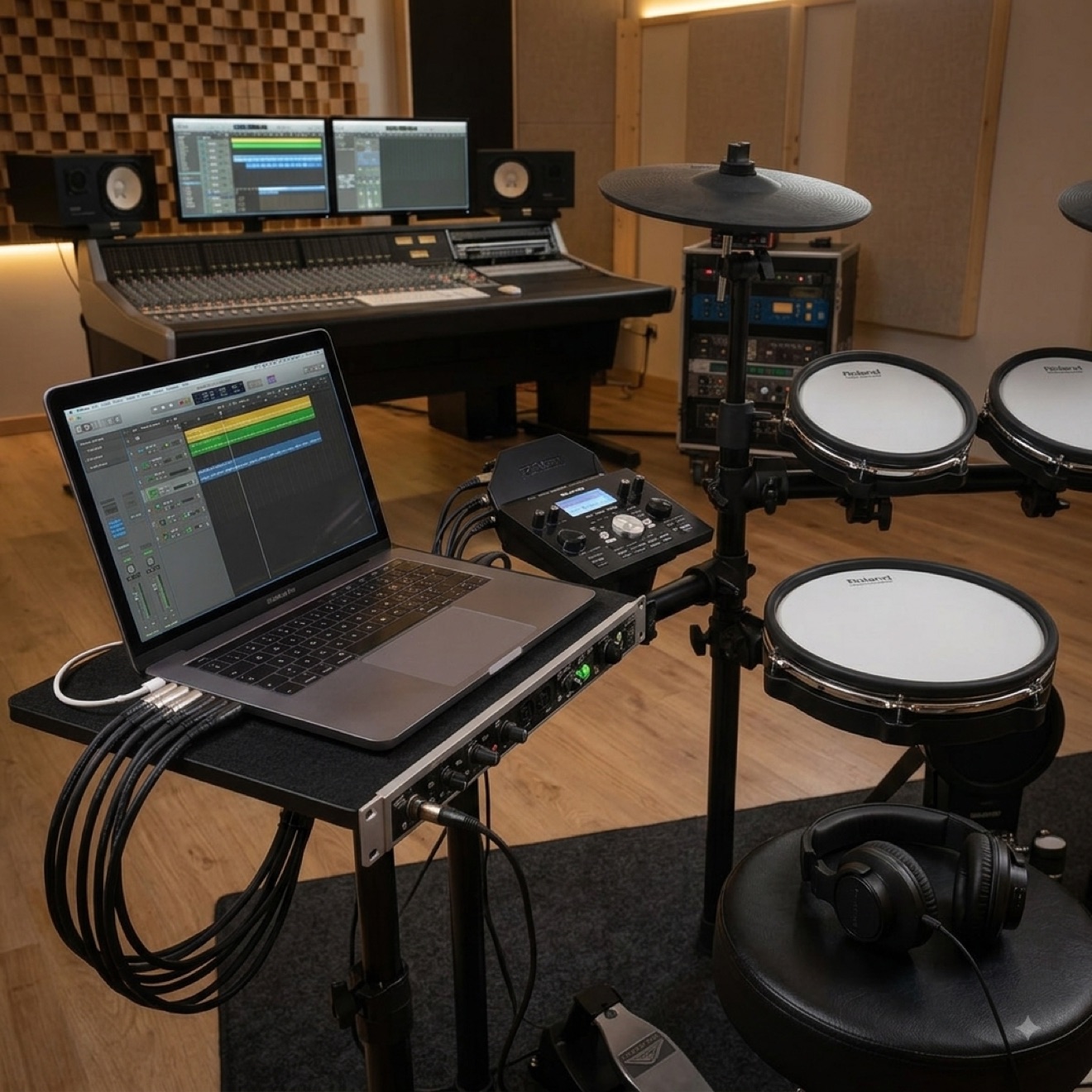
Once connected to a computer we can use software such as:
- EZdrummer,
- Addictive Drums,
- BFD,
- Steven Slate Drums,
- GarageBand,
- Logic Pro.
That opens access to huge libraries of professionally recorded drum kits.
In practice it means that even after several years we don't have to change the whole kit just because we want a different sound. We can simply connect the kit to a computer.
The Black Hawk Pulse supports USB MIDI, so it can be used both for practice and for recording.
And Bluetooth?
Bluetooth is a fine example of a feature that was an add-on a few years ago and today can genuinely make daily practice easier.
The Pulse offers both Bluetooth Audio and Bluetooth MIDI.
Bluetooth Audio lets you quickly play a backing track, a song or a tutorial from your phone and play along with it. With no cable running across half the room.
That is a convenience many people use far more often than the several hundred exotic sounds hidden in the module.
What is not always worth paying extra for?
Big numbers look very good on the boxes of electronic drum kits. 500 sounds. 700 sounds. 100 ready-made kits.
Do you really need 14 kinds of cowbell, 20 electronic effects and several dozen exotic instruments?
For some users — of course. But most drummers spend the overwhelming part of their time with a handful of favourite kits.
So instead of asking: "How many sounds does the module have?" it is worth asking: "How well does the instrument respond to what I do with the sticks?"
This is exactly where the differences emerge that often can't be seen in a table of parameters.
You can have hundreds of sounds, but if the snare misreads a rimshot, doesn't respond to where it was struck, or the sensor starts missing single strokes after a while, the user will very quickly begin to feel the instrument's limits.
It is the same with the display. A large colour screen looks impressive, but it doesn't improve the response of the snare, the reliability of the sensors or the dynamics of the ride.
If our budget is limited, it is decidedly better to invest it in the pads, the sensors, the quality of the components and the construction of the instrument.
And kits at 5000, 10,000 or 20,000 złoty?
In the highest price class we get solutions intended for very demanding users and professionals.
Among other things you may find:
- large pads close in size to acoustic drums,
- more advanced systems for detecting the position of the stroke,
- elaborate modules,
- enormous sound libraries,
- additional audio outputs,
- advanced routing,
- constructions that look almost identical to acoustic kits.
Are they better? Of course.
But another question arises: will a beginner or intermediate drummer really use the capabilities they are paying several thousand extra for?
Not necessarily.
The best electronic drum kit isn't always the most expensive one
When choosing a kit it is worth looking at the ratio of price to the elements that have a direct bearing on playing and on the instrument's durability.
If the budget is limited, the order of priorities should look roughly like this:
a good snare → good sensors → dynamics and detection of the stroke position → durable components → mesh pads → kick → cymbals → a steady rack → module and connectivity → extra features.
It is according to this philosophy that we created the Black Hawk Pulse.
Instead of competing on the number of features printed in small type in the manual, we concentrated on what a drummer is in contact with at every stroke:
- mesh pads,
- a four-sensor snare,
- correct rimshot detection,
- cross stick support,
- a progressive response from the edge to the centre of the head,
- multi-zone cymbals,
- a quiet kick,
- a steady construction,
- durable sensors and components.
Added to that are Bluetooth Audio/MIDI and the ability to work with a computer and popular virtual instruments.
Thanks to that the Pulse is a kit you can buy as your first serious set of drums, but one that shouldn't quickly start limiting you as your skills develop.
So how much does a good electronic drum kit cost?
There is no single specific figure.
For somebody beginning their adventure with drums it is, however, more sensible to buy a well-equipped, solidly made mid-range kit than the cheapest model, which after a few months will start limiting your progress or needing repairs.
What matters most is not how much we pay. What matters most is: what we pay for.
It is worth paying extra for the things we'll feel with every stroke of the stick — good pads, appropriate sensors, a larger snare, correct detection of techniques such as rimshot and cross stick, progressive dynamics, multi-zone cymbals, a solid construction and durable components.
We can take a far more cautious view of features that look splendid in a specification table but which, once the instrument is bought, we'll use twice.
A good electronic drum kit should not merely sound good on the first day. It should respond correctly after tens of thousands of strokes and make you still want to play it.
And that is precisely the investment that pays back the most.
Frequently asked questions
How much does a sensible electronic kit for a beginner cost?
The most interesting range is around 1500–3000 złoty. Below that figure you usually get rubber pads, a small rack and a simplified kick pad. Above it you are mainly paying for solutions intended for advanced users.
Is a more expensive electronic kit always better?
Not always in practice. A higher price often means an elaborate module and a greater number of sounds rather than a better pad response. It is worth checking what exactly you are paying extra for — pads, sensors and construction are felt with every stroke, hundreds of sounds usually are not.
What is worth paying extra for first?
For the snare and the sensors. Most strokes are played on the snare, so its size, the number of sensors and correct detection of rimshot and cross stick have the greatest bearing on playing comfort and on learning technique.
Does the number of sounds in the module matter?
In everyday playing decidedly less than the descriptions on the box suggest. Most drummers use a handful of favourite kits. If we want different sounds, it is enough to connect the kit to a computer via USB MIDI.
How can you tell a kit will survive years of playing?
You won't read that from the specification. It is worth asking about the durability of the sensors and how often pad failures occur — typical symptoms of wear are missed single strokes, an erratic tom or a cymbal zone behaving randomly.
You'll find current prices and exactly what goes into each set in the electronic drum kits.
This article was originally written in Polish and translated with the help of automated tools. If anything is unclear, please contact us.