
 Čeština
 Slovenčina
 Hrvatski
 Română
 Magyar
 български език
 Deutsch
 Français
 Українська
 Nederlands
 Polski
How to start playing electronic drums?

Setting the stool, holding the sticks, your first beat and the metronome — a practical plan for the first weeks with the instrument.
The kit stands unpacked in the corner of the room, the sticks are lying on the stool and the question arises: where do you actually start? Below we describe the first weeks as they really look — without promising that after a month you'll play like a professional.
First, sit properly
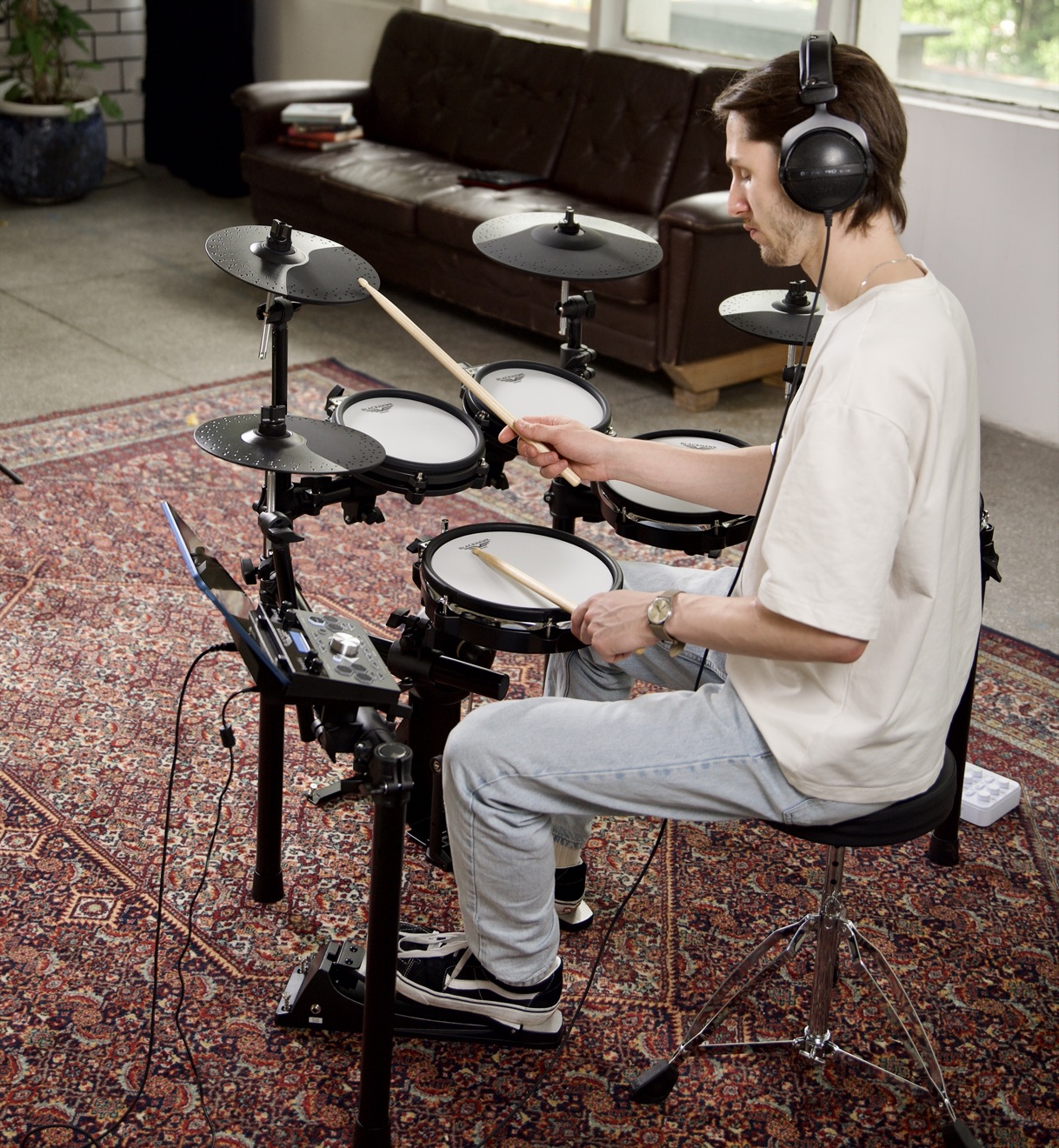
It sounds trivial, yet it is the most common source of later problems. Set the stool so that your thighs slope slightly downwards and your knees are bent at a little more than a right angle. A drummer sitting too low loses control of the pedal and after an hour their lower back hurts.
The snare should sit between your legs, at roughly waist height. The cymbals low enough that you don't have to lift your arms — playing happens with the wrists, not the shoulders. Spend the first quarter of an hour on this instead of adjusting your setup for months afterwards.
Holding the sticks
The stick should rest in your hand, not be squeezed in it. The balance point is roughly one third of the way from the end — that is where it rebounds best. The grip is formed by thumb and index finger, the remaining fingers only guide.
The test is simple: drop the stick on the pad and let it bounce a few times on its own. If it rebounds freely, your grip is right. If it dies immediately, you are squeezing too hard.
Your first beat
Start with the simplest pattern: kick on "one" and "three", snare on "two" and "four", hi-hat evenly on every quarter. This is the beat a huge part of popular music rests on — and it is enough to play along with hundreds of songs.
Practise it slowly. Really slowly, for instance at sixty beats per minute. Speed comes by itself, whereas mistakes drilled in quickly stay for years.
The metronome from day one
You have one in the module, so there's no excuse. Playing without a metronome feels more pleasant at the start and is the shortest route to uneven time, which is hard to repair later.
A good exercise: set the metronome to click only on "two" and "four". That forces you to hold the pulse yourself and teaches you to play with a band.
Play to music, not only to exercises
The greatest advantage of an electronic kit over an acoustic one in learning is that you hear the backing track in your headphones together with the instrument, with no fight over volume. Choose songs with a simple, clear beat and play along with the recording — you'll learn more than from drills alone, and keep your enthusiasm into the bargain.
In the Black Hawk Pulse kits you can connect a backing track by cable or wirelessly, and the module mixes it with the sound of the instrument.
How much to practise
Twenty minutes a day gives far better results than three hours once a week. Muscles and motor memory need regularity, not bursts. If one day you have no energy, play ten minutes of plain rudiments on the snare — that is still better than a break.
When to think about a teacher
There is so much material online that it will comfortably see you through the first months. A teacher is useful at two moments: at the start, to set your technique and stop mistakes becoming ingrained, and later, when you feel stuck despite practising regularly. Even a few lessons can save months of wandering.
Frequently asked questions
Can I manage to learn on my own?
Yes, plenty of people do. It is worth recording yourself after a few weeks and listening from the outside — you then hear things you don't notice while playing, especially uneven time and left-hand strokes that are too hard.
How long until my first song?
With regular practice a simple rock song at a slow tempo is within reach after a few weeks. Fluent playing with fills and changes is more a matter of months.
My wrists hurt. What am I doing wrong?
Almost always you are squeezing the sticks too hard or playing from the shoulders instead of the wrists. Go back to the stick-rebound test and practise more slowly. Pain is not a normal stage of learning and should not be ignored.
Where should I start with reading music?
With rhythmic notation — on drums you don't read pitches, only note values and their placement in the bar. Knowing quarter notes, eighths and sixteenths is enough to read most beginner material.
Is a practice pad worth using?
Yes, for rudiments it is even more convenient — you can practise in front of the television or while travelling. It won't replace playing on the kit, though, because it doesn't train limb independence.
For a start, a complete kit with nothing left to buy separately works best. We have gathered such options among the Black Hawk electronic drum kits.
This article was originally written in Polish and translated with the help of automated tools. If anything is unclear, please contact us.