
 Čeština
 Slovenčina
 Hrvatski
 Română
 Magyar
 български език
 Deutsch
 Français
 Українська
 Nederlands
 Polski
How do electronic drums work?
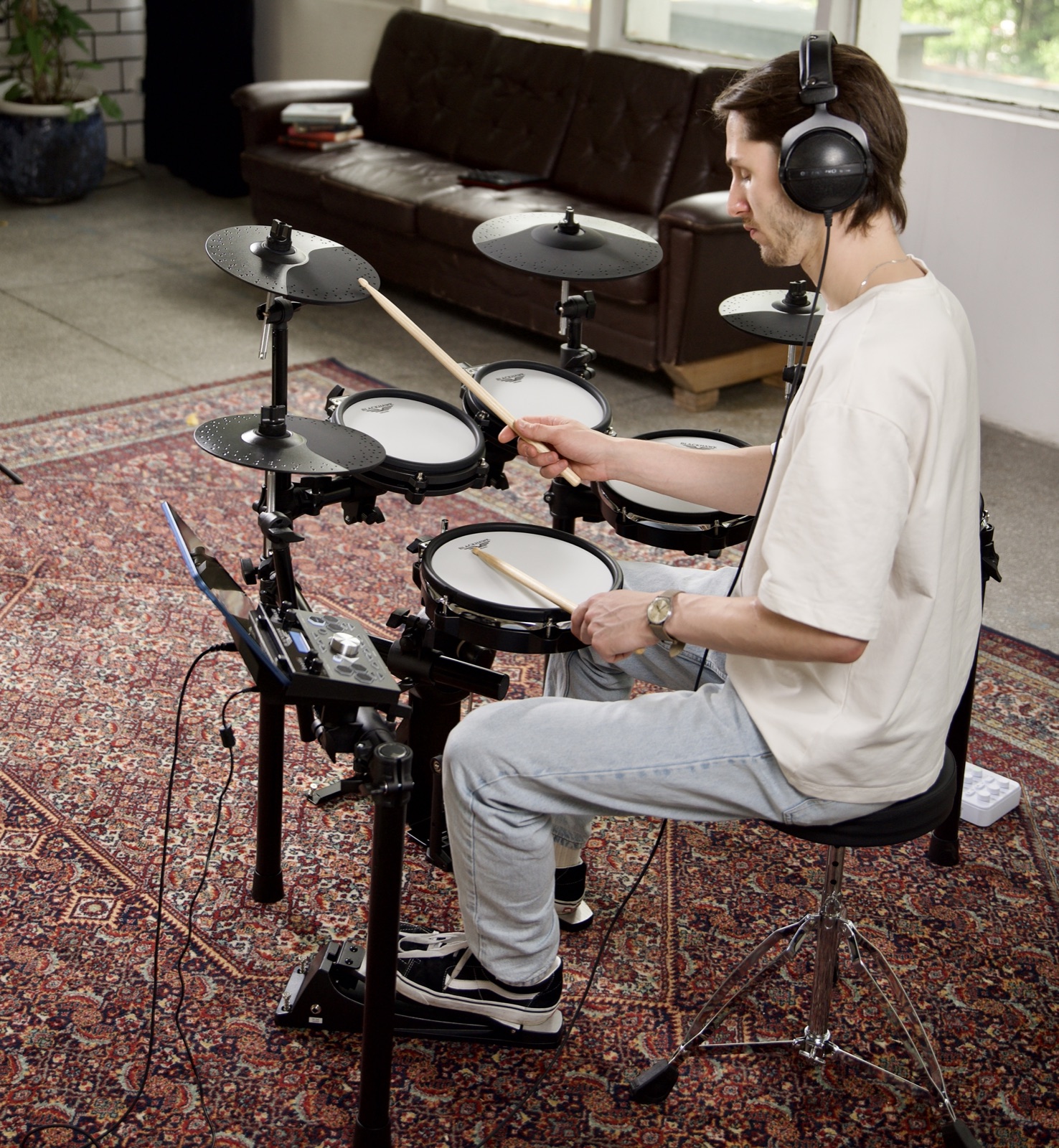
From the piezoelectric sensor under the head to multi-layered samples — what happens between the stroke and the sound in your headphones.
From the outside it looks simple: you hit a pad, you hear a drum. Inside, however, a few things happen that are worth knowing about — because they decide whether the instrument sounds natural or "electronic".
The path from stick to sound
Under the head of every pad sits a piezoelectric sensor. A stroke flexes it for a fraction of a second, and it converts that flex into an electrical impulse — the harder the stroke, the higher the voltage.
The module measures that impulse and answers two questions: what was hit and how hard. It then reaches into memory for the matching recording and plays it back. The whole thing takes a few milliseconds — short enough for the ear to perceive it as an instant response.
Why good kits sound natural
If the module held a single snare recording in memory and merely turned it up for a harder stroke, it would sound artificial. A real drum doesn't simply get louder when hit hard — it changes colour, has more high frequencies and a different decay.
That is why multi-layered samplesare used: a dozen or more separate recordings of the same drum, made at different strengths. The module picks the layer matching your stroke. That is how the modules in the Black Hawk Pulse kits work, and it is precisely this feature that separates an instrument for playing from a toy.
Zones, or one pad meaning several sounds
A force sensor alone is not enough — on a real snare you play the centre of the head, the rim and along it.
A three-zone snare distinguishes a head stroke, a rimshot and a cross stick. Toms with active rims respond to an edge stroke. A three-zone ride distinguishes the bow, the edge and the bell. Cymbals additionally detect the touch of a hand and then damp the decay — exactly as with acoustic brass.
The hi-hat, the hardest element
The hi-hat has to know not only that it was struck, but also how far open it is at that moment. That is handled by a separate sensor at the pedal, which measures its position continuously. The module recognises at least three states: closed, half-open and open, and in good designs also the transitions between them as well as the "chick" of the pedal itself without a stick.
The mesh head
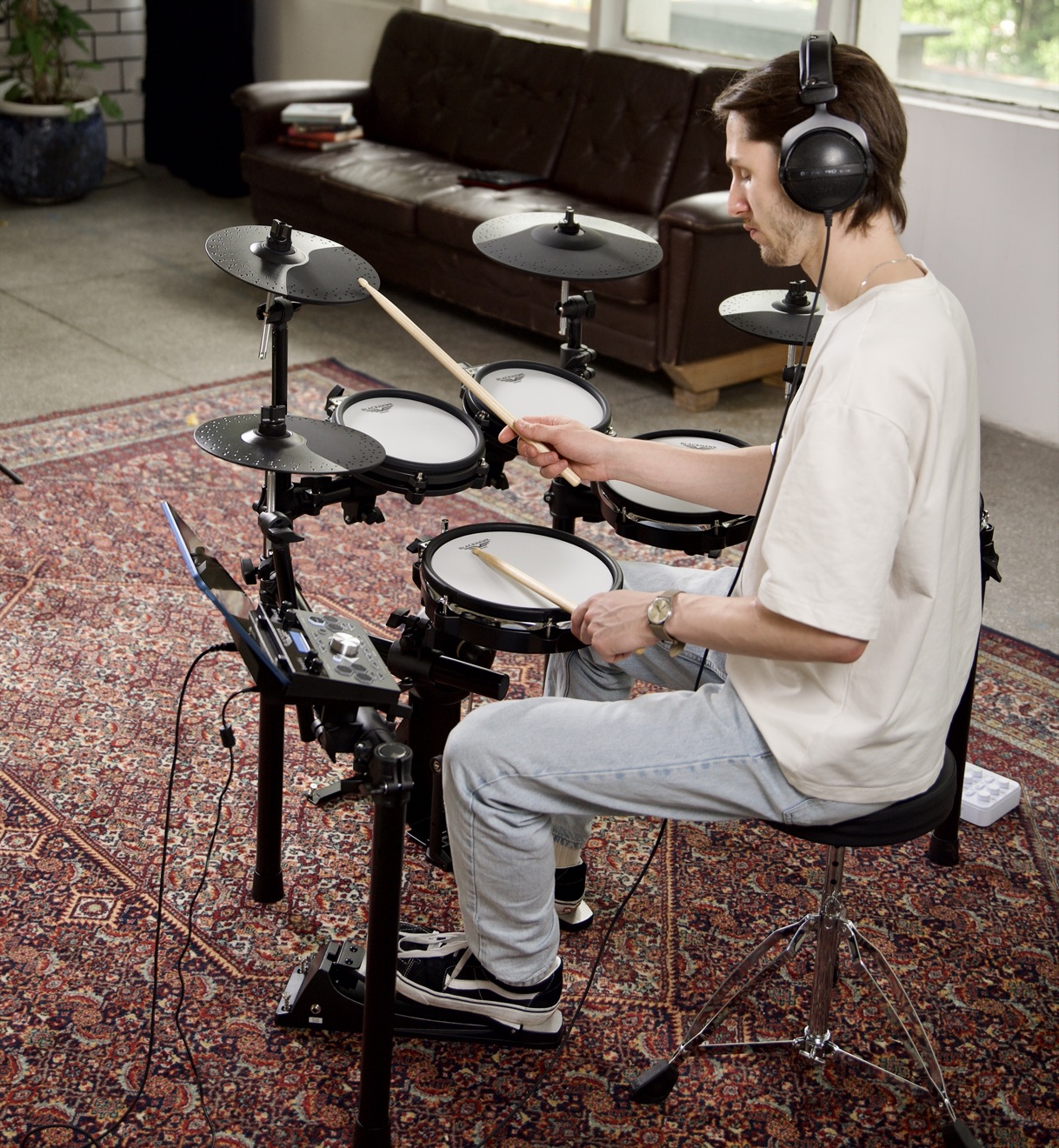
Mesh serves two purposes at once. First it quietens — instead of a bang, a stroke gives a soft tap. Second it rebounds the stick much like a real head, and you can adjust its tension with a key, just as on an acoustic kit. Rubber pads offer neither.
What the module does beyond playing sounds
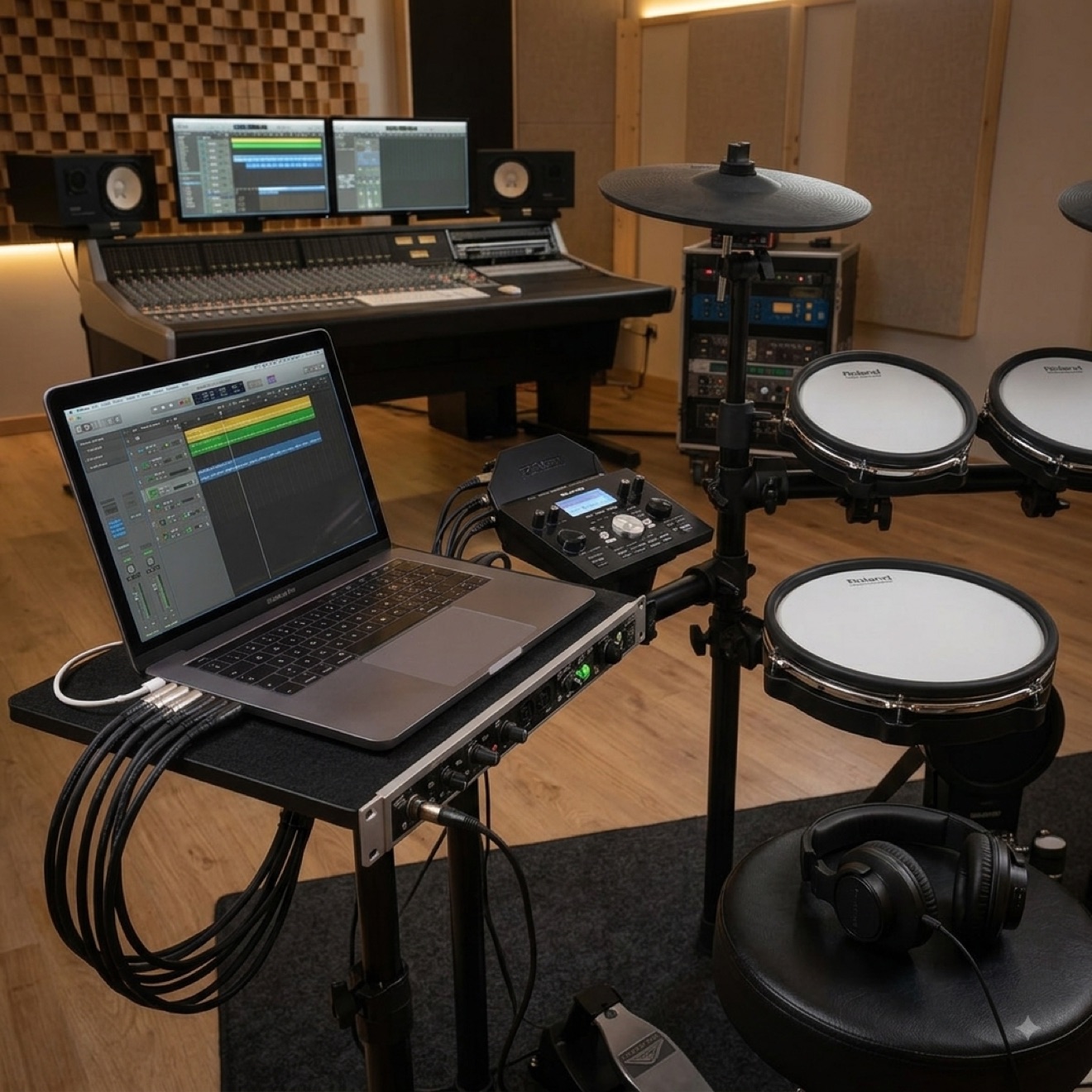
It stores ready-made kits of sounds, lets you balance the volume of individual elements, has a metronome and a recording function. It also sends a MIDI signal over USB, so it can drive drum software on a computer. Newer designs add Bluetooth for playing along to a backing track from a phone and support for dedicated learning apps.
Frequently asked questions
Is there a microphone in the pad?
No. The pad doesn't record sound — it measures only the force of the stroke. That is why a conversation in the room or noise from outside has no effect whatsoever on what you hear in your headphones.
Where does latency come from and is it noticeable?
The module's own latency is a few milliseconds, less than sound needs to travel two metres through air — it cannot be felt. The problem only appears when playing through a computer with a badly configured audio driver.
Why does one pad sometimes sound when I hit the neighbouring one?
That is crosstalk, vibration carried through the rack. It is prevented by setting sensitivity and threshold in the module and by tightening the mounts. In a properly configured kit the phenomenon doesn't occur.
Can I load my own sounds?
It depends on the module — some designs allow it. The simpler route, however, leads through a computer: you connect the kit with a USB cable and use sound libraries in software, with practically any kit at your disposal.
Do the pads wear out?
Yes, mesh is a consumable, much like a head on an acoustic kit. With daily playing it is replaced once every few years, and replacement takes a few minutes.
How these elements work in specific models is described with each of the electronic drum kits — from the construction of the pads to the capabilities of the module.
This article was originally written in Polish and translated with the help of automated tools. If anything is unclear, please contact us.